

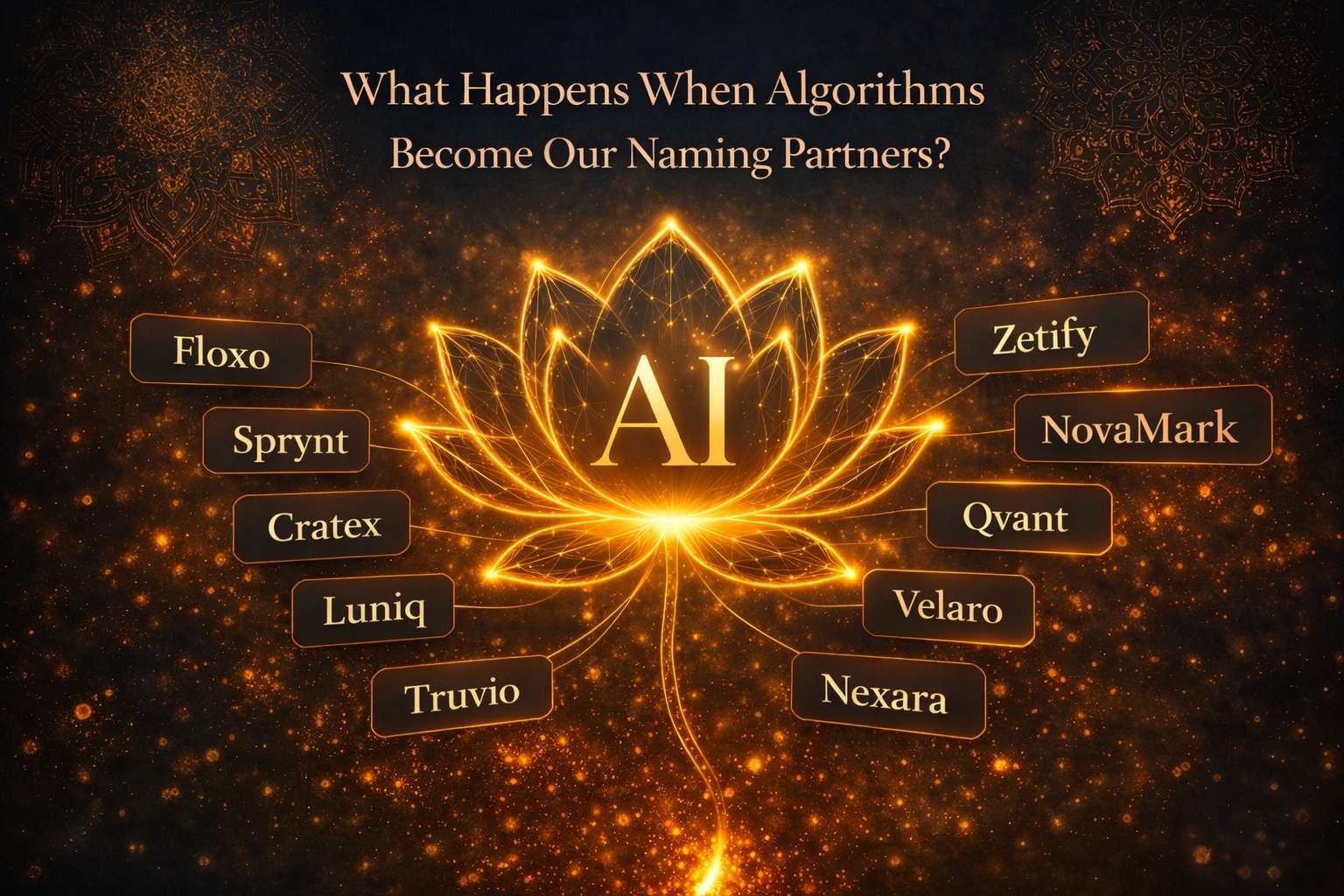
After exploring automations for tasks ranging from coding to customer support, startups are outsourcing the task of naming their business to AI.
Generic tools aside, global platforms like Canva and GoDaddy now offer AI-powered business name generators. With these tools, founders can now generate hundreds of potential brand names within minutes simply by entering keywords, industry categories, tone preferences, and target audience details. For India’s fast-growing startup and direct-to-consumer (D2C) ecosystem, the convenience and economics are hard to ignore.
However, brand naming consultants believe the rise of AI-generated naming is also exposing a new set of business challenges around trademark conflicts, weak differentiation, digital discoverability, and multilingual scalability.
Similar Inputs, Similar Outputs
AI naming tools rely on predictive language models, which are trained on existing naming patterns, keyword associations, and linguistic structures. In sectors already crowded with digitally native startups, this can create what branding experts describe as “name clustering,” where multiple brands share comparable phonetics, suffixes, spelling styles, or naming formats.
Hitesh Talreja, Founder of Tiepograph, a brand naming agency working with Indian startups, explains, “If ten brands in the same category sound alike, customers can’t distinguish one from the other.”
Customer acquisition costs (CAC) for brands with generic names skyrocket as brands spend more aggressively on paid advertising and retention campaigns. It becomes more challenging as users frequently search for brands verbally, through voice assistants, or on marketplaces with crowded search results.
Trademark Risks Emerging as a Startup Pain Point
One of the biggest criticisms of AI-powered naming systems is the lack of integrated legal validation. While AI generators can list brand names based on relevance and creativity, the suggested names are not automatically checked for trademark availability, domain ownership, or legal clearance across markets.
“A common misconception is that if an AI tool generates the name, it must automatically be available,” Hitesh adds. “But generation and legal ownership are completely different processes.”
This creates a growing operational risk for startups that move quickly from naming to packaging, marketing, and launch without conducting deeper trademark checks. Amazon Seller Central’s brand name generator advises users to consult trademark attorneys separately before finalizing a business identity.
With more startups joining the ecosystem in India, trademark filings have consequently accelerated. Founders operating in saturated sectors often discover that many obvious naming combinations, particularly short English words, invented spellings, and modern-sounding hybrids are already registered or too similar to existing brands.
India’s Multilingual Market Adds Another Layer of Complexity
Furthermore, India’s multilingual consumers add to the nuance of brand naming. Unlike startups operating primarily in single-language markets, Indian brands often need names that function across English and multiple regional languages simultaneously.
A name that sounds premium in English may become difficult to pronounce in Tier 2 and Tier 3 markets. In some cases, phonetic similarities can unintentionally create awkward or negative associations in regional languages.
This creates limitations for AI systems that rely heavily on literal keyword generation and pattern prediction.
“The Indian market is linguistically layered,” said Hitesh. “A startup today is not just building for one city or one language. The name has to travel across geographies, accents, and digital platforms.”
Industry observers say this becomes especially important for D2C startups aiming for national scale, influencer-led growth, or omnichannel expansion.
Why Human-Led Naming Still Holds Relevance
AI-assisted brand naming is rapid; however, it triggers a debate around the missing strategic creativity. “Sure, an exhaustive list is ready in less than a minute,” explains Hitesh, “but it lacks emotional positioning, phonetic behaviour, linguistic adaptability, and an understanding of consumer psychology.”
As is seen in tech and marketing, AI tools are driving the production line under human supervision. Some branding firms, too, are now using hybrid approaches where AI is used for early-stage ideation while human teams conduct refinement, legal screening, and strategic evaluation.
This model is becoming increasingly common among funded startups looking to reduce creative timelines without compromising brand distinctiveness.
A Shift From Creativity to Business Infrastructure
As barriers to launching businesses continue falling through AI automation, no-code tools, and digital commerce infrastructure, differentiation itself is becoming harder to achieve. That is placing greater pressure on startups to create identities that are not only visually appealing but also legally defensible, digitally searchable, and culturally scalable.
Industry observers believe the future of AI-assisted naming is unlikely to be fully automated or fully human-led. Instead, the market may move toward collaborative systems where AI accelerates ideation while human expertise handles strategy, validation, and contextual judgment.
For startups navigating crowded digital markets, the challenge may no longer be simply finding a name quickly, but finding one capable of surviving scale.
